
New Construction & Remodel Electrical
Designed before it is buried in the wall.
Or call us at 419-262-0078.
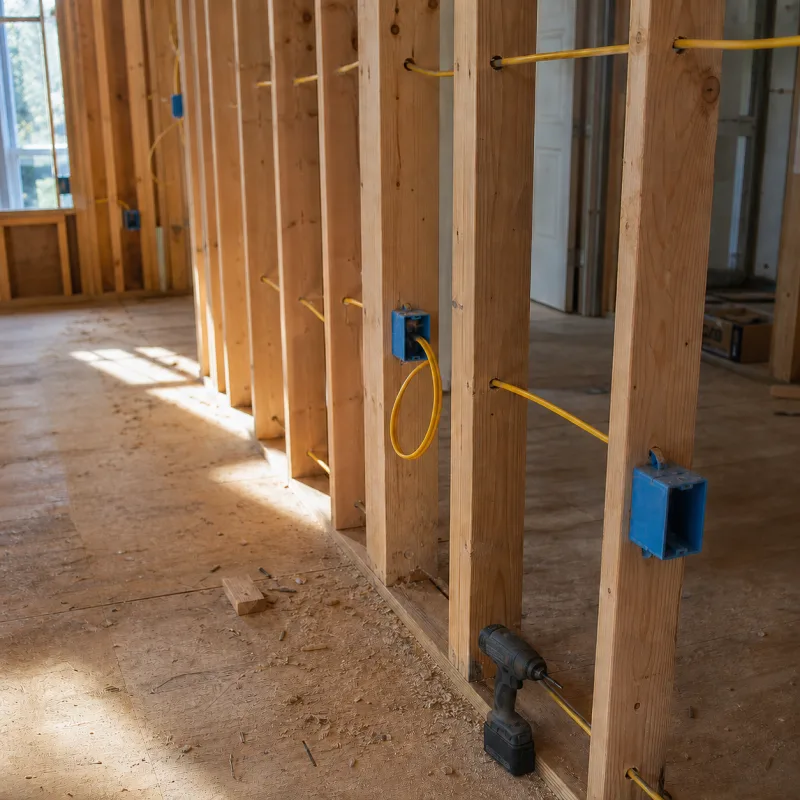
Lighthouse Electric wires new construction, remodels, and additions across Point Place, Toledo, and the I-75 corridor south toward Dayton. We also take on rewiring in houses that are still standing, still occupied, and still have to run every day the job is going on.
Casey Grup is an Ohio licensed electrical contractor, license #50207. Lighthouse carries general liability insurance, is bonded, and carries workers' compensation. About half our work is residential and half is commercial, so working around a restaurant's operating hours or a medical office's schedule is routine here, and so is working in somebody's house while they live in it.
New construction
On a new build we start from the plans and the builder's schedule. Before rough-in we walk the plan with you and mark what the drawings do not settle: where the island receptacles land, which switch controls what when you walk in the door, whether the garage is getting a car charger now or a conduit run for one later. Those decisions are cheap while the walls are open and expensive after drywall.
Rough-in is the phase where we set boxes, drill and pull the branch circuits, run the feeders, and set the panel. We coordinate that with the framers, the plumber, and the HVAC contractor so nobody is boring through somebody else's work. We schedule the inspection, drywall goes up, and we come back for trim: devices, plates, fixtures, the panel labeled, and the whole thing energized and tested.
We handle the permit and the inspection scheduling as part of the job. You are not chasing paperwork.
What we need from you
- Plans or a set of drawings, even preliminary ones
- The builder's target dates for rough-in and trim
- Fixture selections, or a decision to let us spec standard fixtures and swap later
- Anything you know you want down the road (a shop circuit, a hot tub, a generator, an EV charger), so we can rough it in now
Remodels and additions
Remodel work is different from new construction because the house is already yours and you are still living in it. We plan the job around that. In most cases we keep the house energized and only kill the circuits we are actually working on, and when a full shutdown is coming you hear about it from us ahead of time rather than that morning.
Kitchens usually carry the most electrical work in a remodel. A kitchen wired for a range, a fridge, and one counter outlet is not the same kitchen as one running an induction cooktop, a wall oven, a microwave drawer, and a coffee setup on the same counter. We look at what you are putting in, run new circuits back to the panel for it, and check whether the panel itself still has room. You hear that at the estimate, not after demolition.
Bathrooms, basement finishes, garage conversions, and additions follow the same pattern: new circuits, sometimes a subpanel, and a look at whether the existing service can carry what you are adding. If it cannot, an electrical panel upgrade gets folded into the project. A 100 to 200 amp upgrade runs about $5,200, and we quote it as part of the remodel rather than as a surprise.
Whole-house rewiring
Point Place and the older neighborhoods around it have a lot of houses wired decades before anyone was running a microwave, a window unit, and a home office at the same time. Two-prong outlets, one circuit covering half a floor, an extension cord doing permanent work. A rewire is what you do when patching one circuit at a time has stopped making sense.
A whole-house rewire replaces the branch wiring throughout the house: new cable from the panel to every device, new boxes, new receptacles and switches, grounded circuits throughout, and in most cases a new panel to go with it.
What the work is like to live through
A rewire is not invisible while it is happening. Here is what to expect.
- We fish new cable through walls, floors, and ceilings using existing chases, closets, and attic and basement runs wherever we can. Where we cannot, we open the wall.
- Expect some cut-in patches. We keep them small and in the least visible spot available, and we tell you where they will be before we cut.
- Drywall patching and paint are handled by your finisher, coordinated so it happens once at the end rather than in pieces.
- The house stays livable. We work room by room or floor by floor, and in most cases power is back on by the end of the day. When it will not be, you know before we start.
- Furniture gets moved off the walls we are working in. Floors and pathways get covered.
Every rewire starts with a walkthrough. We count devices, look at the attic and basement access, check what is balloon-framed and what is not, and price from what we actually saw. A rewire quoted over the phone is a guess.
Knob-and-tube and aluminum wiring
Knob-and-tube
If you have looked in your basement or attic and seen white ceramic pieces with wire threaded through them, that is knob-and-tube. It is the original wiring in a lot of houses in this area, and most owners find it during a remodel rather than on purpose.
We replace it with new grounded cable run to each of those points and retire the old conductors. In most houses that happens as part of a full rewire, because knob-and-tube is rarely the only original thing left. We can also do it in stages, starting with the circuits that carry the most load. Which approach makes sense for your house is something we tell you after we have seen it.
Aluminum branch wiring
Some houses in this area have aluminum rather than copper on the branch circuits, the ones feeding your receptacles and lights. The work is at the connections: outlets, switches, and splices.
We go through those connection points one at a time and correct each one based on what we find in the box. In some houses replacing the branch wiring outright turns out to be the better answer, and we will say so. Either way the job is methodical: every device, every box, every splice in the house.
If you are not sure which you have, we can tell you. It takes a look in the panel and at a couple of outlets. Our standard service call is $180.
Lighting and custom work
Recessed lighting layouts, under-cabinet and cove lighting, dimming, exterior and landscape lighting, garage and shop circuits, ceiling fans, and dedicated circuits for equipment. On the commercial side we do the same for restaurants, small businesses, medical offices, and manufacturing facilities. If you have a fixture or a control scheme in mind and are not sure it can be done in your building, ask.
What customers say
For service work, repairs, and smaller jobs around the house, see our residential electrical services.