
Electrical Panel Upgrades in Point Place & Toledo
Service capacity for the way a home actually draws power now.
Or call us at 419-262-0078.
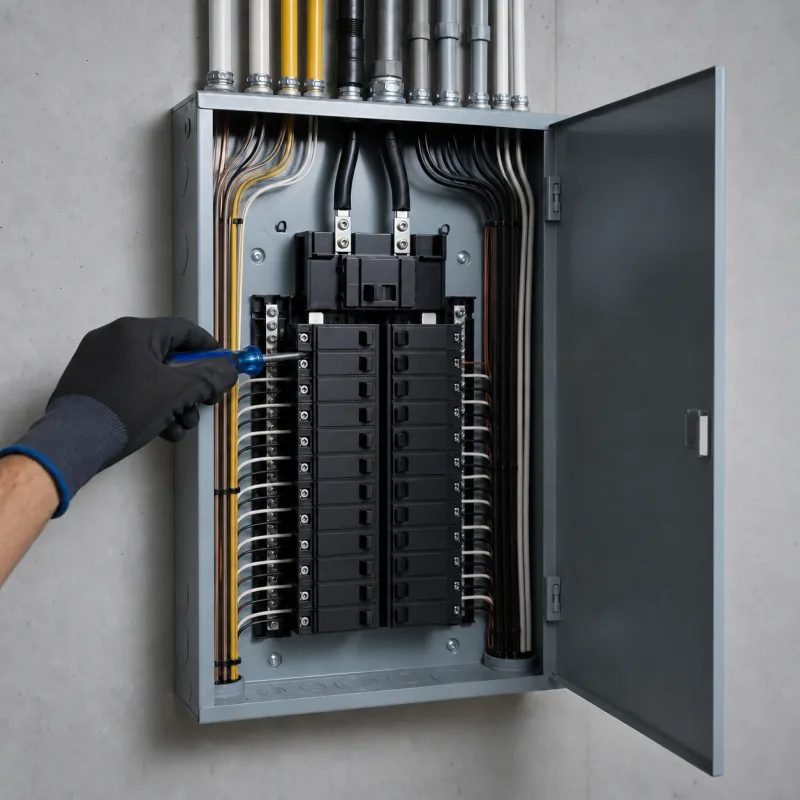
An electrical panel is the box that takes the power coming into your house and splits it into the circuits that feed your outlets, lights, furnace, and appliances. Every breaker in that box protects one of those circuits. When the panel is old, undersized, or damaged, everything downstream of it is working through a bottleneck.
A panel upgrade replaces that box, and usually the service entrance hardware that feeds it, with a new one rated for more current and built to accept modern breakers. Most homeowners in Point Place come to us for one of two reasons: the panel they have is causing problems today, or they are adding something (an EV charger, a heat pump, a garage full of tools) that the existing panel cannot support.
Signs your panel needs replacing
Breakers tripping under normal load
A breaker that trips once during a storm is doing its job. A breaker that trips every time the microwave and the toaster run together is telling you the circuit is carrying more than it was built for. If you are already thinking about which appliances you can run at the same time, the panel is the thing to look at.
No room left for new circuits
Open the door and count the empty slots. If there are none, or if someone has doubled up breakers to make room, you have no capacity for anything new. A finished basement, a new range, a well pump, or a workshop all need somewhere to land, and a full panel means the answer is a new panel first.
Older fuse boxes and panels
Houses in Point Place run the full range of ages, and we still find fuse boxes and mid-century panels in service. Screw-in fuses are the obvious case. Less obvious are certain older breaker panels that are hard to find parts for and that most electricians will not add to. If you are not sure what you have, take a photo of the inside of the door and the label, and we can tell you on the phone what you are looking at.
Adding an EV charger, heat pump, or shop equipment
These are the big new loads. A Level 2 charger, a heat pump, a welder, or a compressor each want a dedicated circuit with real capacity behind it. Casey is a Qmerit certified installer, and on a fair number of jobs the charger install and the panel upgrade get done together because the panel is what makes the charger possible. You can read more about EV charger installation if that is what you are planning.
What a panel upgrade costs
A typical 100 to 200 amp upgrade runs about $5,200. That covers the common version of the job: new panel, new breakers, new service entrance hardware, reconnecting the existing circuits, and the permit and inspection work that goes with it.
What moves the number:
- The condition of the meter and the mast. If the mast is rusted, bent, or pulling away from the house, it gets replaced as part of the job.
- How far the service entrance runs. A short run from the meter to the panel is straightforward. A long run through a finished space is not.
- Where the panel sits. A panel in an open basement is easy to work. One buried in a closet, behind shelving, or in a crawl area takes longer, and sometimes it makes sense to relocate it.
- Whether the utility has to disconnect. Some jobs need the power company on site to pull and reset the service, and that has to be scheduled around.
Separately, our standard service call or diagnostic visit is $180. That is for troubleshooting a specific problem: a dead circuit, a breaker that will not hold, an outlet that stopped working. If you want a quote on a panel upgrade, call and we will talk through what you have before anyone schedules anything.
How long it takes and what happens to your power
Plan on the power being off for a good part of a day. The work happens in a set order: the utility disconnects, the old panel comes out, the new one goes in, the circuits get landed and labeled, the utility reconnects, and the inspection follows. Most of that is one working day on site.
We coordinate the utility and the inspection ourselves. We pull the permit, schedule the disconnect and reconnect, and meet the inspector. You do not need to chase anyone or sit on hold. What we ask from you is access to the panel area and a heads up if anything in the house cannot lose power for a stretch, like a medical device, a sump pump during a wet week, or a freezer you would rather we plan around.
Normal lead time is about a week. We work Monday through Friday, 7am to 5pm, out of our trucks, so there is no shop to visit. Lighthouse carries general liability insurance and workers' compensation, and we are bonded. Ohio license #50207.
200 amp or 400 amp: how to think about which you need
For most houses in this area, 200 amps is the answer. It handles a normal set of appliances, central air, a workshop's worth of tools, and a Level 2 EV charger without you thinking about it again.
The 400 amp conversation comes up when the house has a lot going on at once: electric heat plus electric cooking plus two chargers, a large addition, a detached garage or shop with its own subpanel, or a lake-side property with a dock, a lift, and outbuildings on the same service. It is a bigger job with heavier hardware and more utility involvement, so it is worth being clear about whether you actually need it.
The useful way to think about it is not today's bill but the next ten years. If you are planning an addition, a second charger, or converting from gas to electric heat, say so when you call. It is cheaper to size for that once than to upgrade twice.
What customers say
If your problem is a single dead circuit or a breaker that keeps tripping rather than the panel itself, start with our page about residential electrical repairs.